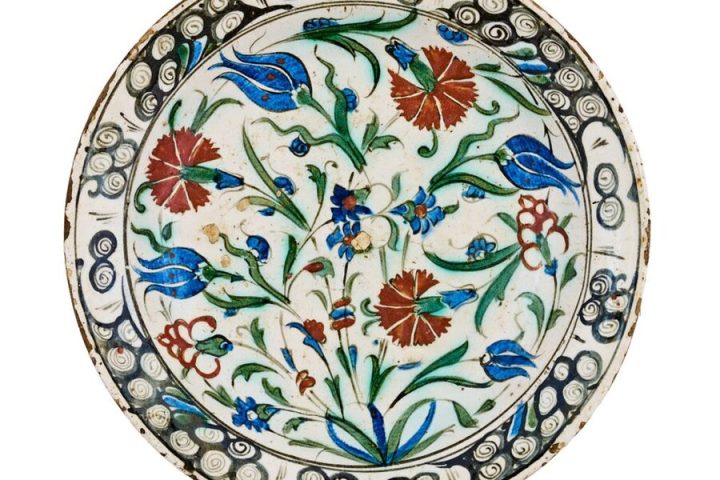
The pottery of Iznik, a small town south-east of Istanbul, is among the most instantly recognisable in the world. Its brilliant cobalt, turquoise and — from the 1550s — a raised sealing-wax red were produced for the Ottoman court and its mosques, and today the dishes, tiles and jugs of Iznik are cornerstones of Islamic art collections everywhere.
Reading a dish
Iznik design moved quickly through distinct phases. Early blue-and-white wares of around 1480 to 1520 borrow from Chinese porcelain; the “Golden Horn” style of the 1530s adds delicate spiralling scrolls; and by the mid-sixteenth century the celebrated saz leaves, tulips, carnations and hyacinths appear in full polychrome. Knowing the sequence helps a collector date a piece within a decade or two.
What to look for
Condition, colour and drawing are the three tests. Chips and old restorations are common on pieces that have been in use for four hundred years and are not disqualifying, but they must be declared. A crisp red that stands proud of the glaze, a confident freehand outline and a well-fitted foot ring all point to a good workshop. Later Kütahya wares and nineteenth-century European imitations are often offered as Iznik; our specialists examine every lot in person.
At Kew
Ottoman ceramics feature regularly in our Islamic art sales, from single tiles to important dishes. If you have pieces to sell, or would like advice on building a collection, please get in touch.